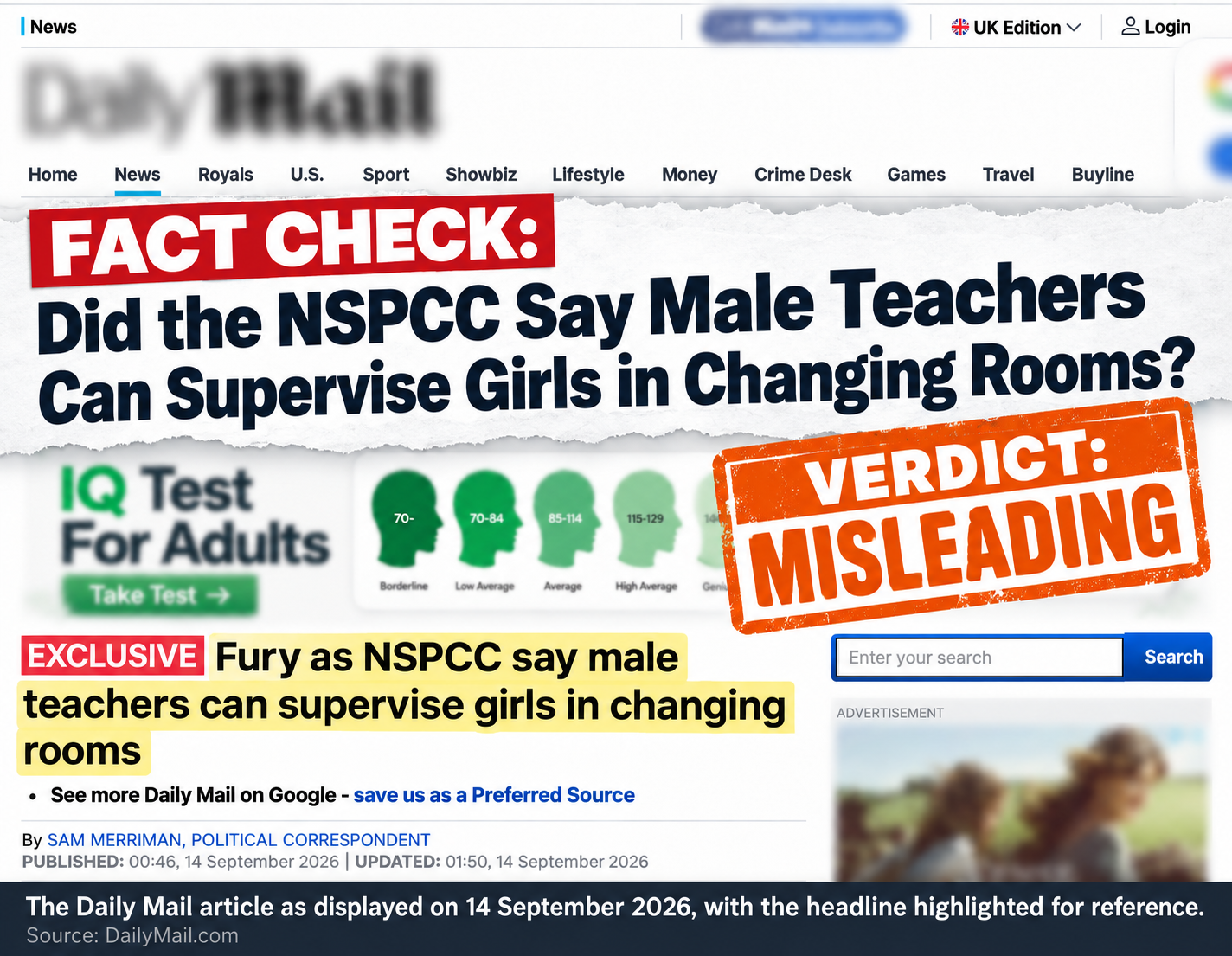
A Daily Mail report prompted outrage from JK Rowling, Sharron Davies and others after claiming male teachers would be allowed to supervise girls while changing. The NSPCC says that is not what its guidance says; but there is a genuine change behind the controversy.
VERDICT: MISLEADING
The NSPCC did remove an explicit recommendation that, where possible, adults supervising children getting changed should be of the same gender as them.
However, its replacement guidance does not state that male teachers should, or now may, supervise girls while they change.
The distinction became important on Monday after a Daily Mail report prompted a wave of anger towards the children’s charity, with high-profile social media accounts sharing the story with millions of followers.
The Mail published its report under the headline:
“Fury as NSPCC say male teachers can supervise girls in changing rooms”
The article went further than simply reporting that a sentence had been removed. Its opening presented the consequence as a fact, saying “Male teachers will be allowed” to supervise female pupils while they changed at swimming pools or sports centres. Contemporaneous copies of the article preserve the same wording.
That is considerably stronger than what the underlying NSPCC document actually says.
What did the NSPCC actually change?
There was a real alteration to the charity’s guidance, and ignoring it would give an incomplete picture.
An earlier version of the NSPCC’s Safeguarding considerations for changing rooms briefing advised:
“Where possible, the adults who are supervising children getting changed should be of the same gender as them.”
An archived copy of that briefing confirms the wording.
When the NSPCC published an updated schools briefing in August 2026, that sentence was no longer included.
This is a legitimate change to scrutinise. Critics are entitled to question why an explicit recommendation was removed rather than, for example, amended from “gender” to “sex”.
Campaign group Sex Matters has done exactly that, arguing that the omission creates unnecessary ambiguity for schools.
But removing an instruction recommending same-gender supervision is not the same thing as issuing a new instruction permitting opposite-sex supervision.
That second step is where the viral account of the story goes beyond the text.
What does the new guidance say?
The current NSPCC schools briefing says schools should determine appropriate supervision according to the age and developmental needs of children.
It says adults ordinarily should not need to remain inside a changing room simply to maintain good behaviour. Staff can remain nearby and enter if necessary; for example, in response to bullying or a disturbance.
When an adult does need to enter, the NSPCC says children should be warned in advance and given the opportunity to cover themselves. It also says staff should never stand watching children change or repeatedly enter without good reason.
There is no passage in the document saying male teachers should supervise girls changing, female teachers should supervise boys, or that opposite-sex supervision has been newly authorised.
The August briefing does, however, no longer contain the previous explicit same-gender recommendation.
That distinction is central to this fact-check.
The NSPCC’s other current guidance still recommends same-sex supervision
There is another important piece of context absent from the viral claim.
The NSPCC operates separate safeguarding guidance for sport and leisure organisations. That guidance was updated on 6 August 2026; the same month as the revised schools briefing.
It states that where adults and children have to use changing facilities at the same time, supervision should involve at least two members of staff “of the same sex as the children.”
That makes it difficult to characterise the NSPCC’s institutional position as one which positively endorses men supervising girls while they undress.
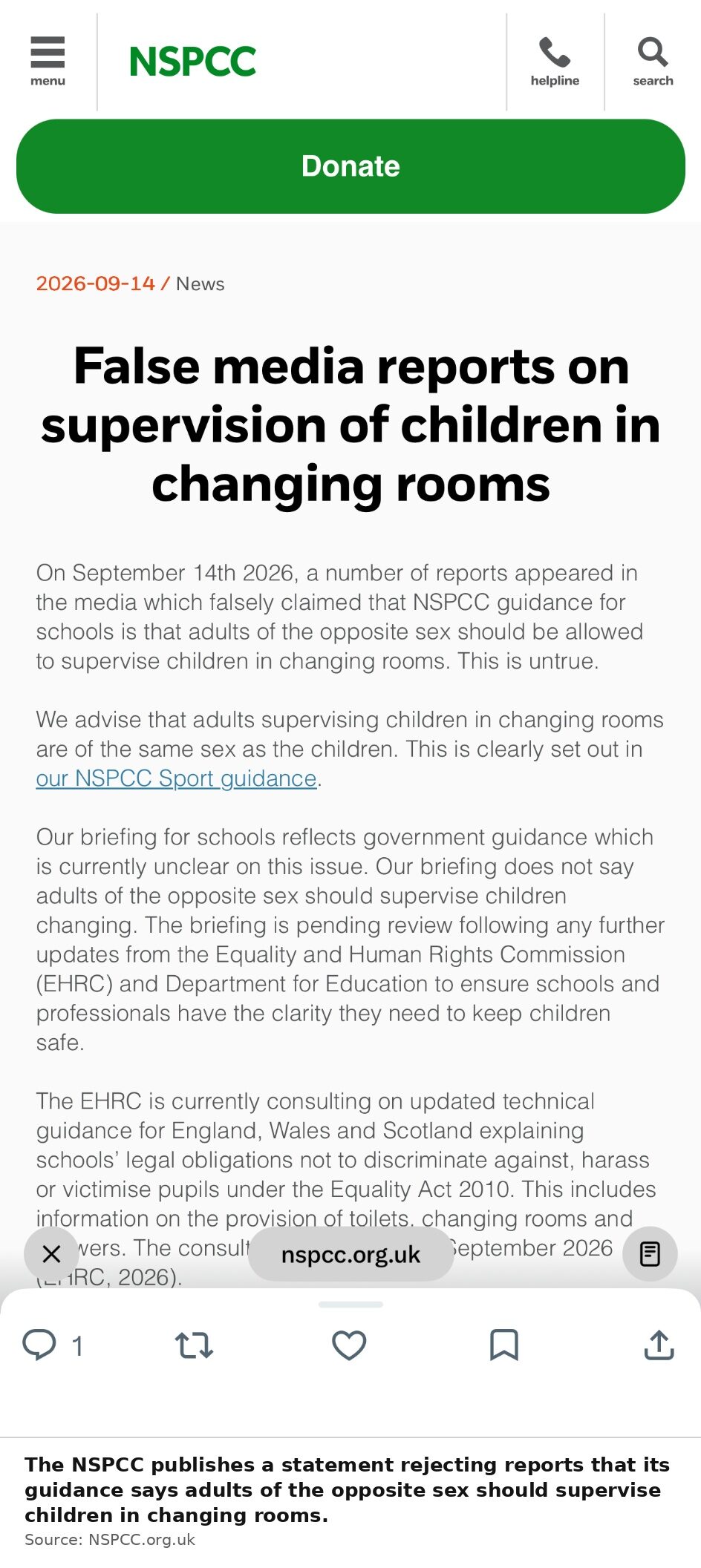
On 14 September, as the newspaper reports and social-media reaction spread, the NSPCC issued a direct public statement headed “False media reports on supervision of children in changing rooms.”
The charity said reports claiming its guidance allowed opposite-sex adults to supervise children changing were “untrue”and reiterated that it advises same-sex supervision.
It added that the schools briefing is now pending review while it awaits further guidance from the Equality and Human Rights Commission and Department for Education.
What does government guidance say?
This part of the story is more complicated than either side’s social-media version suggests.
The Department for Education’s statutory Keeping Children Safe in Education 2026 guidance requires schools in England to protect pupils’ privacy and maintain suitable changing facilities.
For children aged 11 and over, it says schools must not allow a child to undress in front of a child of the opposite biological sex and must not allow pupils to use changing rooms designated for the opposite sex.
However, the relevant section does not set out an equivalent explicit rule specifying the sex of the member of staff who may enter or supervise a changing room.
The NSPCC itself describes the current government position on that particular issue as unclear.
That ambiguity provides grounds for debate about whether the NSPCC should have retained a clearer recommendation.
It does not, however, establish that the charity issued guidance saying male teachers can supervise girls.
Where do JK Rowling, Sharron Davies and Adam Brooks fit in?
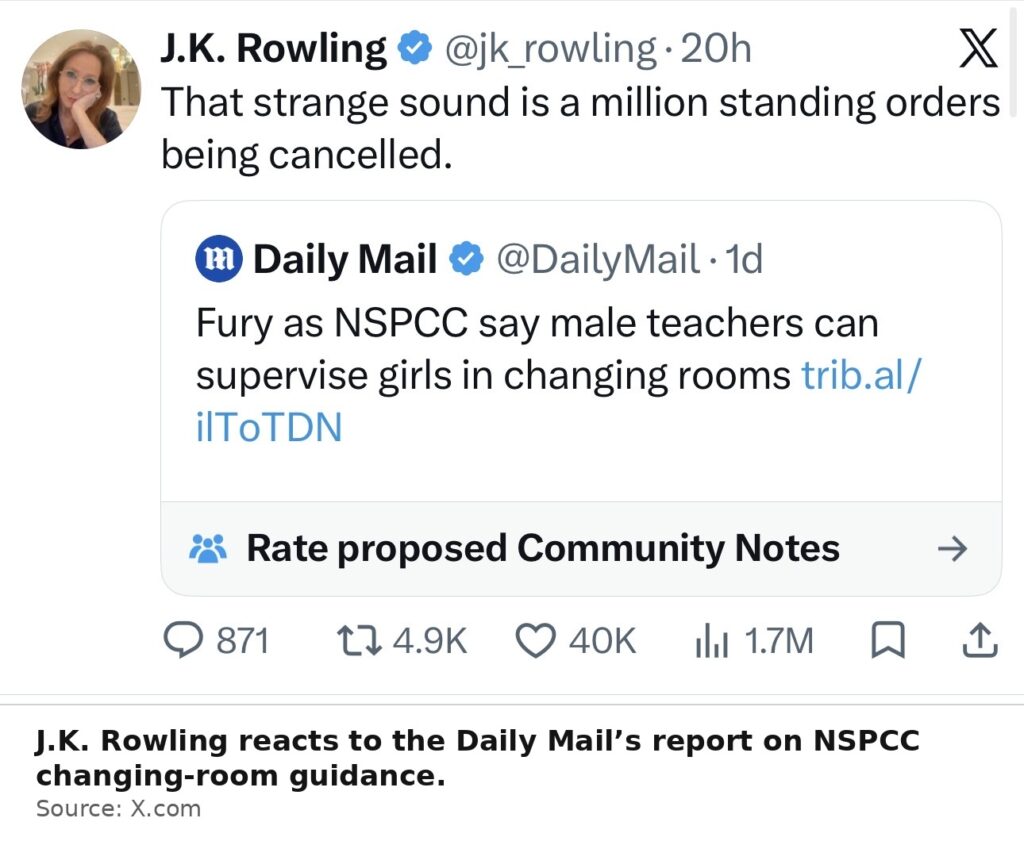
JK Rowling shared the Daily Mail’s post and wrote:
“That strange sound is a million standing orders being cancelled.”
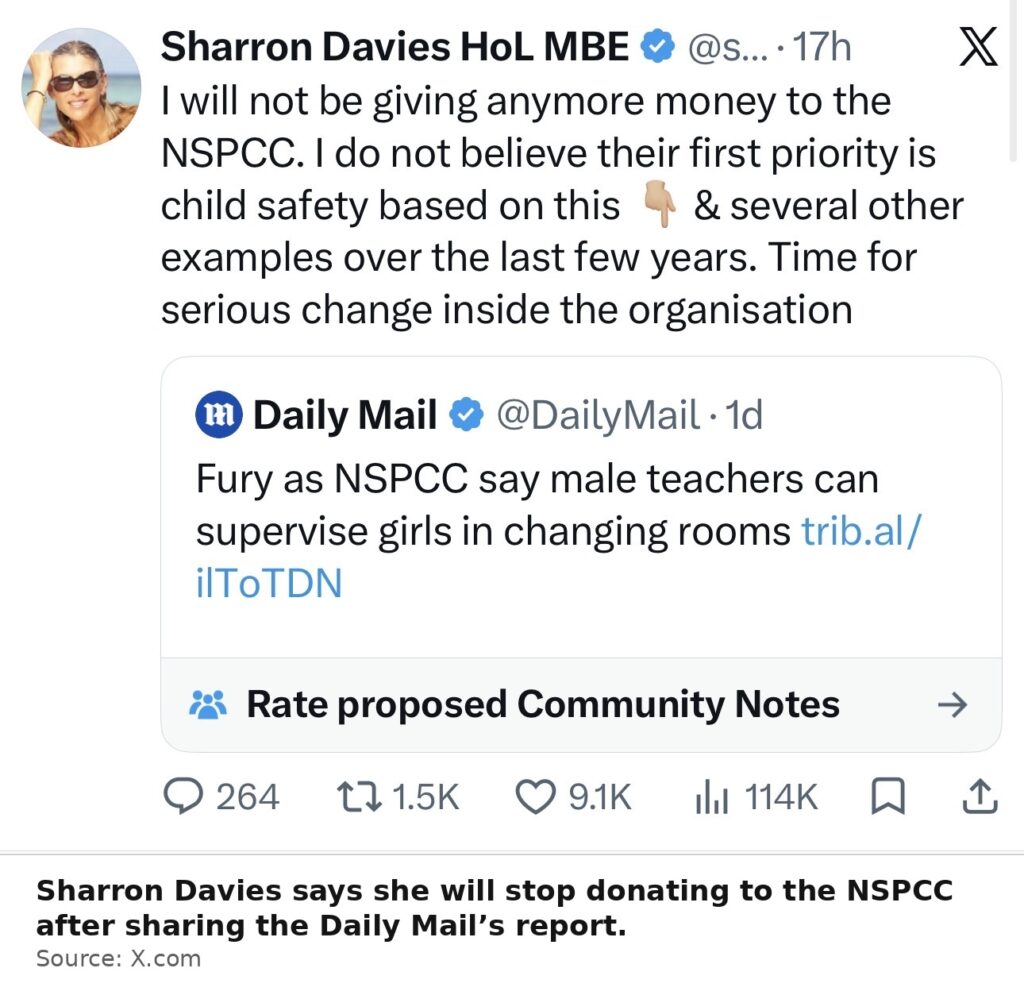
Former Olympic swimmer Sharron Davies said she would no longer donate to the NSPCC and questioned whether child safety remained its first priority.
Publican and commentator Adam Brooks similarly shared the Mail’s report, saying he would be outside his daughter’s school gates “if this happens.”
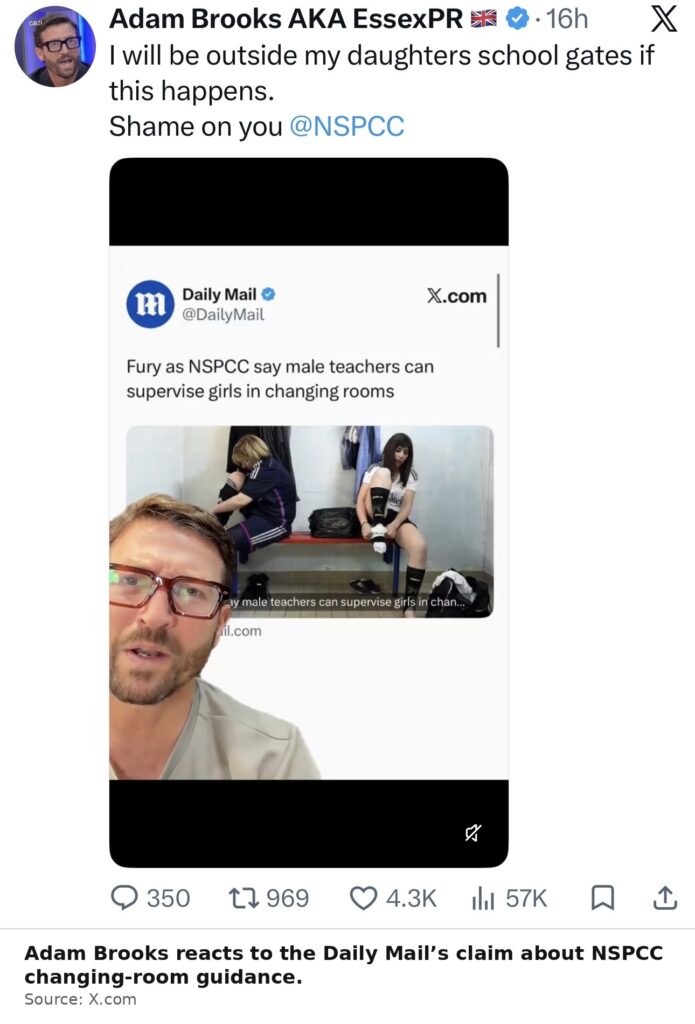
It would be unfair to suggest that these three independently invented the underlying claim.
The Daily Mail’s own headline told its readers that the “NSPCC say male teachers can supervise girls”, while the article’s opening presented opposite-sex supervision as something that would now be allowed.
Their posts are therefore more accurately described as reactions to, and amplification of, the newspaper’s framing of the story.
That does not make the information reaching their audiences accurate, but it identifies where the disputed factual proposition entered the chain.
So what is true?
There are several separate claims being collapsed into one.
It is true that the NSPCC removed an explicit recommendation from its schools briefing saying, where possible, supervising adults should be the same gender as the children.
It is also fair to question that decision. The new schools briefing is less explicit on the sex of supervising staff than its predecessor.
But the NSPCC did not replace that wording with guidance saying male teachers may or should supervise girls changing.
Its current sport safeguarding guidance expressly recommends same-sex supervision, and the charity has now publicly reaffirmed that this remains its advice.
The Daily Mail therefore took a genuine omission from the revised guidance and presented one possible implication of that omission as an affirmative change in NSPCC policy.
That is why Just The Facts rates the claim “NSPCC says male teachers can supervise girls in changing rooms” as MISLEADING rather than entirely false.
The underlying deletion happened.
The reported new instruction did not.
The primary documents are available directly from the NSPCC’s August 2026 schools briefing, its current NSPCC Sport changing-room guidance, the charity’s 14 September response to the media reports and the Department for Education’s Keeping Children Safe in Education 2026 guidance.